 how-to
How to Verify a Locksmith's Professional Credentials
Table of Contents
- Why Verifying a Locksmith's Credentials Matters Before You Hire
- How to Spot a Rogue Locksmith: A Red Flag Checklist
- Step-by-Step: How to Verify a Locksmith's Professional Credentials
- Master Locksmiths Association Member Check: How to Do It
- DBS Checked Locksmith Requirements: What to Ask For
- Digital Verification Tools and Vehicle-Specific Locksmith Checks
- Post-Service Verification: Confirming the Work Was Done Right
- Frequently Asked Questions
Last Updated: September 16, 2026
Why Verifying a Locksmith's Credentials Matters Before You Hire
Handing your car keys to a stranger at the roadside is a leap of trust worth taking the time to verify locksmith credentials first. Learning how to verify a locksmith's professional credentials protects your vehicle, your wallet, and your personal data.
How to Spot a Rogue Locksmith: A Red Flag Checklist
A rogue locksmith presents as a legitimate trade professional but lacks the credentials, insurance, or accountability to back it up, and most give themselves away before the job starts.
Red Flags Before the Job Starts
- Quotes a price on the phone without asking your vehicle's make, model, or year
- Refuses to give a business name, trading address, or company number
- Arrives in an unmarked vehicle with no signage or branding
- Pressures you to pay a deposit before attending
- Cannot name a professional association or accreditation scheme
Red Flags During and After the Job
- Demands cash only, with no receipt or invoice offered
- Claims the job is "more complex than expected" and inflates the price on site
- Damages the lock or ignition and blames the vehicle
- Disappears without providing proof of work or a service agreement
Step-by-Step: How to Verify a Locksmith's Professional Credentials
To verify locksmith credentials, follow a simple sequence: confirm who they are, confirm they are licensed and registered, then confirm they are insured.
Step 1: Ask for Photo Identification and Proof of Identity
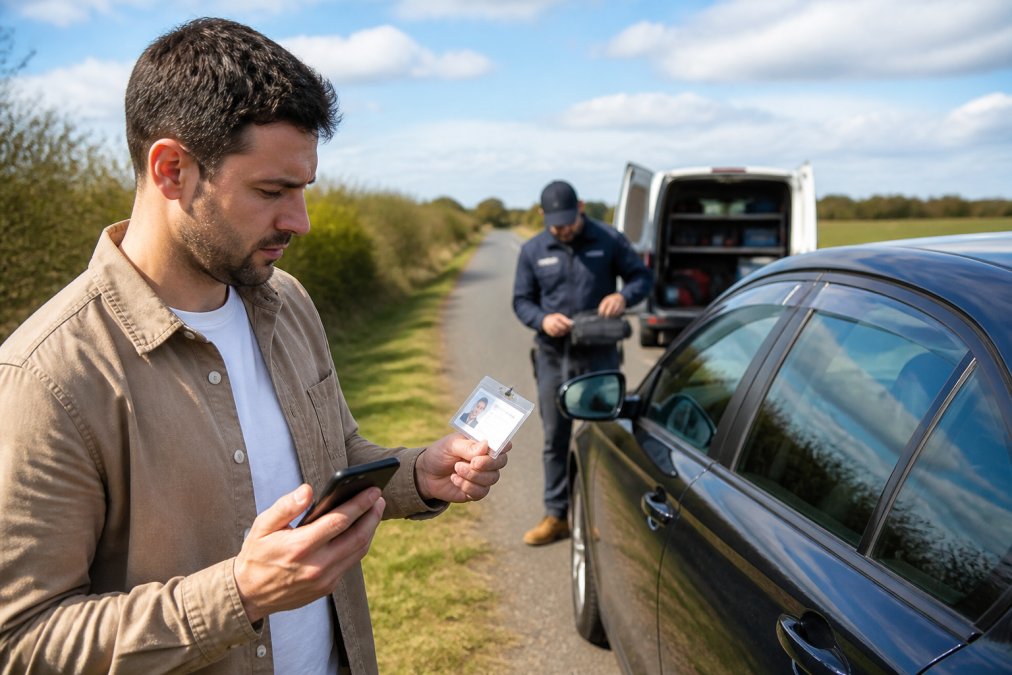
Every legitimate locksmith should hand over photo identification without hesitation. Ask to see a driving licence or passport and match the name to the business they claim to represent. If the name on the ID does not match the trading name, ask why. A genuine operator will explain; a rogue one will deflect.
Step 2: Check Trade Licences and Business Registration
Ask for the company's business registration details and check them against the official register held by Companies House. A registered business has a paper trail, a named director, and something to lose. An operator who cannot produce a registration number is trading outside the system, which means you have no route to redress if the work fails.
Step 3: Confirm Insurance Coverage and Professional Liability
Request proof of insurance before work begins. A credible locksmith carries professional liability cover so damage to your vehicle is not your problem to fund. Ask for the policy certificate and confirm the cover is current; if they cannot produce it, treat that as a refusal to be held accountable.
| Verification Step | What to Request | Why It Matters |
|---|---|---|
| Identity | Photo ID matching the trading name | Confirms you know who is working on your car |
| Registration | Company number for a register check | Gives you a route to redress |
| Insurance | Current policy certificate | Covers accidental damage |
| Accreditation | Association membership number | Signals trade accountability |
Master Locksmiths Association Member Check: How to Do It
A Master Locksmiths Association member check is the fastest way to confirm an operator meets a recognised trade standard. The Association maintains a public directory of vetted members, and you can search it directly through the Master Locksmiths Association before anyone arrives.
DBS Checked Locksmith Requirements: What to Ask For
A DBS checked locksmith has undergone a criminal record check through the Disclosure and Barring Service, which operates the criminal records checking service for England and Wales. For any trade involving entry to vehicles, homes, or premises, this is a meaningful signal of security vetting, but only if you understand what the certificate proves and how to confirm it is genuine.
The Three Levels of DBS Check
Ask which level of check the locksmith holds, because the three tiers cover very different ground:
- Basic check, confirms unspent convictions and conditional cautions only. This is the minimum, and it is the level most self-employed locksmiths will hold.
- Standard check, adds spent convictions, cautions, reprimands, and warnings that are not protected. Relevant for roles with regular contact with the public.
- Enhanced check, includes everything in a standard check plus a check of local police records for relevant intelligence. This is the level expected for anyone working with children or vulnerable adults, and it is the strongest signal available.
How to Actually Verify a DBS Certificate
A certificate is issued to the individual, not the company. A firm cannot hold a DBS check on behalf of its staff, so a locksmith who says "the company is DBS checked" is describing something that does not exist in that form.
To verify what you are shown:
- Check the certificate is in the locksmith's own name, matching the photo ID they presented.
- Look at the issue date. A basic check has no formal expiry, but most employers and trade bodies treat anything older than three years as stale. A recent certificate tells you far more than one from a decade ago.
- Check the level stated on the certificate against what the job requires.
- Ask whether the certificate is registered with the DBS Update Service. This is the single most useful verification step. The Update Service is a subscription that lets the certificate holder share their status with employers and lets you check, with the individual's consent, whether anything has changed since the certificate was issued. If the locksmith is subscribed, they can give you their consent for a status check, and that check reflects the current position, not just the position on the day the certificate was printed.
What a DBS Check Does Not Tell You
A DBS check is not a licence or a guarantee of competence or honesty. It confirms the absence of certain recorded convictions on a given date, and says nothing about workmanship, insurance, or whether the person will inflate a bill on site. Treat it as one layer of verification alongside registration, insurance, and association membership, not a substitute for any of them.
DBS Checks and Self-Employed Locksmiths
Many locksmiths work as sole traders. A sole trader cannot be DBS checked by a company, because there is no company to request the check, but they can apply for a basic check on themselves, and some trade bodies require it as a condition of membership. If a self-employed locksmith claims a DBS check, ask to see the certificate issued in their own name and confirm the level.
Digital Verification Tools and Vehicle-Specific Locksmith Checks
Most guides tell you to "do your research" without saying where. This section names the actual registers and lookup routes, then covers the credential differences that matter when the job is on a vehicle rather than a front door.
The Registers Worth Checking
A few minutes with the right register confirms most of what you need:
- Companies House (Companies House), search the trading name or company number. You can confirm the company exists, see its registered office address, check its filing history, and identify its directors. A company that has never filed accounts or has been struck off is a warning sign. Sole traders are not on Companies House, so absence here is not automatically a red flag, but a claimed limited company that does not appear is.
- Master Locksmiths Association directory (Master Locksmiths Association), the public member search confirms whether a claimed membership number is genuine and current. This is the fastest single check for trade accountability.
- Trading Standards and local authority consumer protection services, your local authority's trading standards team can tell you whether a business has a history of complaints or enforcement action. Many councils publish trader approval schemes, and membership of one is a useful signal.
- The DBS Update Service, as covered above, this lets you confirm a certificate is still current with the holder's consent.
- TrustMark (TrustMark), the government-endorsed quality scheme for trades working in and around homes. Not all locksmiths are registered, but those who are have been assessed on technical competence and customer service.
- Review platforms, treat these as a starting point, not a verdict. Look for reviews that mention specific jobs, dates, and outcomes rather than generic praise, and be alert to clusters of five-star reviews posted within a short window.
Why Vehicle Work Needs Different Credentials
A locksmith fully qualified for domestic lock work is not automatically equipped for vehicle work, and the credentials that matter are different.
Ask these questions before booking:
- Can you program a replacement key for my specific make, model, and year?
- Do you carry the diagnostic equipment for my vehicle on the van, or do you need to order it in?
- Can you confirm the key type, transponder, remote, or keyless-go, before attending?
- Are you able to extract a broken key or decode a lock without damaging the vehicle's immobiliser?
A Quick Digital Verification Sequence
If you have two minutes and a phone, do this in order:
- Search the trading name on Companies House. Confirm the company exists and is active.
- Search the claimed membership number on the Master Locksmiths Association directory.
- Ask for the DBS certificate and, if the holder is on the Update Service, request a status check.
- Ask the vehicle-specific questions above and listen for whether the answers are specific or vague.
Post-Service Verification: Confirming the Work Was Done Right
The job is not finished when the engine starts. Post-service verification confirms the work was completed to standard and that you have the paperwork to prove it.
Frequently Asked Questions
How do I know if a locksmith is legitimate?
Ask for photo identification and a business card before any work starts, then check the company's registration on the Companies House website. A legitimate locksmith will carry professional credentials, provide a written estimate, and confirm insurance coverage without hesitation. You can also verify membership with a recognised trade association such as the Master Locksmiths Association, which vets members before approval.
Do locksmiths in the UK have to be registered?
There is no single mandatory national licence for locksmiths in the UK, which is why verification matters. Reputable locksmiths join voluntary accreditation schemes like the Master Locksmiths Association, hold public liability insurance, and register their business with Companies House. Some local authorities also require a licence for certain activities. Always ask what professional credentials a locksmith holds and check them independently.
What identification should a professional locksmith carry?
A professional locksmith should carry photo identification such as a driving licence or passport, a business card with the company name and registration number, and proof of trade association membership if applicable. Before letting anyone work on your vehicle, ask to see these documents and cross-check the details against the company's official database entry. If a locksmith refuses to show ID, treat it as a red flag.
Should I ask for a DBS check when hiring a locksmith?
You can ask, but DBS checks are not a legal requirement for locksmiths in the UK. A DBS checked locksmith has undergone a background check through the Disclosure and Barring Service, which adds a layer of security vetting. Some companies voluntarily put all staff through DBS checks. If a locksmith cannot provide one, ask about their recruitment process and whether they use subcontracted workers.