 blog
blog
Is 30-Minute Locksmith Arrival Realistic? The Truth
Table of Contents
- Is 30-Minute Locksmith Arrival Realistic? What the Data Shows
- Locksmith Response Time UK: What Affects Your Wait
- Factors Affecting Locksmith Arrival Time: The Complete Picture
- The Hidden Truth: Why 30-Minute Claims Fail in Reality
- How to Choose an Emergency Locksmith UK: Verification Steps
- Locksmith Prices Emergency Call-Out UK: Understanding the Cost
- Safety Protocols While Waiting for Your Locksmith
- Conclusion: Setting Realistic Expectations for Locksmith Arrival
Is 30-Minute Locksmith Arrival Realistic? The Truth
Last Updated: July 25, 2026
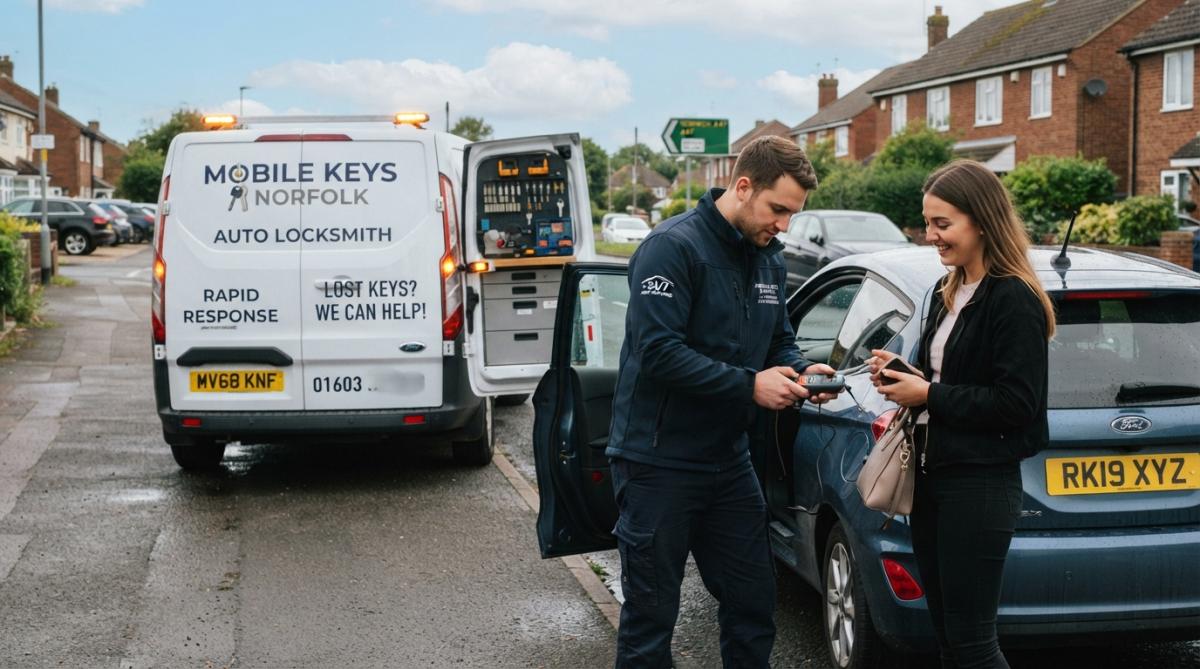
Is 30 minute locksmith arrival realistic? This question sits at the heart of every emergency locksmith search. At Mobile Keys Norfolk, we've fielded this question countless times from drivers locked out of their vehicles. The reality is that while 30-minute arrivals are possible in certain conditions, they're far from guaranteed, and understanding why separates realistic expectations from marketing hype.
Is 30-Minute Locksmith Arrival Realistic? What the Data Shows
A 30-minute arrival time is achievable under optimal circumstances, dense urban area, minimal traffic, nearby technician, straightforward call, but this represents a best-case scenario rather than a standard guarantee. The industry's widespread use of 30-minute promises stems from competitive pressure and selective marketing. Companies advertise their fastest possible times rather than average response times. A locksmith in central Norwich might achieve 30-minute arrivals within a 2-mile radius during off-peak hours, yet take 45-60 minutes for outlying areas or evening rush hour.
The Marketing Promise vs. Real-World Performance
Most emergency locksmith services advertise 30-minute arrival times because it's a psychological threshold. Thirty minutes feels urgent; forty-five minutes feels like a wait. Yet the gap often has nothing to do with competence and everything to do with geography, traffic, and call volume.
When you call a locksmith advertising 30-minute arrivals, you're often seeing their marketing edge, not a commitment. A more honest locksmith might advertise "typically 45-60 minutes" and arrive in 35 minutes, leaving you pleasantly surprised. Instead, you get promises of 30 minutes followed by a 70-minute actual arrival. Peak hours, evening between 5 PM and 9 PM, weekends, and holidays, compress response times across the entire industry.
Geographic Location and Service Radius
Your postcode is the single biggest factor determining realistic arrival times. A technician based in Norwich city centre can service calls within a 3-4 mile radius in roughly 30 minutes during daylight hours. That same technician serving a call 8 miles away in Wymondham faces 45-60 minutes depending on traffic.
Most mobile locksmiths operate within a defined geographic area positioned to minimise travel time, but physics and road networks impose hard limits. Many locksmiths publish tiered service areas with different promised arrival times: primary zone 30 minutes, secondary zone 45-60 minutes, tertiary zone 60-90 minutes or "call for availability." If you're calling from a rural location or outer suburbs, a 30-minute arrival is unrealistic unless the locksmith happens to be extremely close by coincidence.
Locksmith Response Time UK: What Affects Your Wait
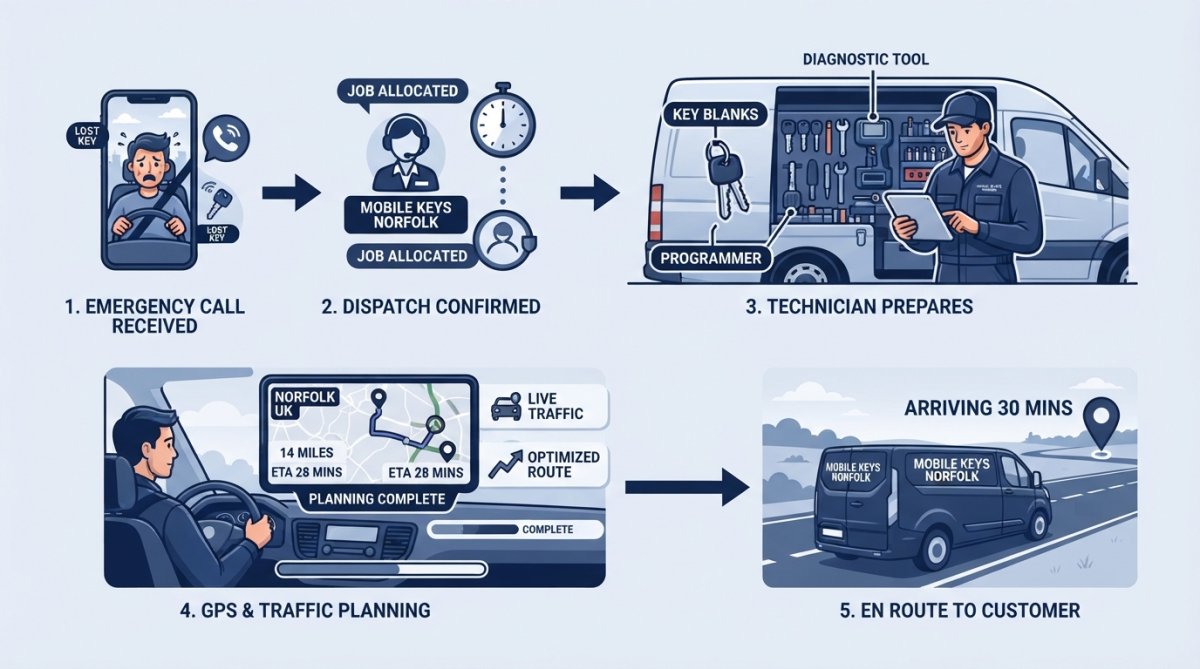
Several interconnected factors determine your actual wait time.
Traffic conditions represent the most unpredictable variable. A locksmith 4 miles away might reach you in 20 minutes at 2 AM but require 50 minutes at 6 PM. The M25 corridor, A11, and A47 are notorious for congestion during peak hours.
Dispatch availability affects how quickly a locksmith can begin traveling. If every technician is occupied, your request enters a queue, adding 20-30 minutes to your wait.
Time of day creates dramatic swings in response time. A 30-minute arrival at 3 PM might become 60 minutes at 7 PM during rush hour. Overnight calls between midnight and 6 AM typically see faster arrivals because traffic is minimal.
Stock availability and equipment on hand affects whether the locksmith completes your job on-site. Modern vehicles with smart keys and immobiliser systems require specific equipment. If a technician arrives without the correct key blank or programming equipment, they must return to base.
Job complexity influences both arrival time and total resolution time. A straightforward car lockout takes 15-20 minutes once the locksmith arrives. A lost key requiring cutting and programming might take 30-45 minutes on-site.
Factors Affecting Locksmith Arrival Time: The Complete Picture
Emergency versus non-emergency service differences matter significantly. A true emergency, stranded on the roadside in rain with young children in the car, might trigger different dispatch priority than a non-urgent lockout where you're safely at home. Some locksmiths operate tiered systems where premium emergency pricing gets priority dispatch.
Peak hours and seasonal demand compress response times across the entire industry. Winter months see more lockouts as cold weather triggers lock failures. Bank holidays and school holidays create predictable surges in demand. During these periods, even efficient locksmiths cannot maintain 30-minute arrivals consistently.
Stock availability and equipment on hand represents a practical limitation many customers overlook. A locksmith with a van stocked with 50 different key blanks and three programmers can handle a wider range of vehicles faster than a technician with limited inventory. Research from the Institute of Automotive Engineers highlights that vehicle security systems have become significantly more complex, requiring locksmiths to maintain extensive equipment libraries.
The Hidden Truth: Why 30-Minute Claims Fail in Reality
The gap between advertised and actual arrival times exists for reasons unrelated to locksmith competence.
The 30-minute claim assumes perfect conditions that rarely align. A technician must be available, positioned nearby, traffic must be light, your location easily accessible, and your job straightforward. When any factor shifts, the timeline extends. Most locksmiths advertising 30-minute arrivals use their best-case scenario as their marketing headline.
Competitive pressure to promise speed creates perverse incentives. When every competitor claims 30-minute arrivals, a locksmith honestly advertising "typically 50 minutes" loses customers to competitors making faster promises, even if those promises are rarely kept.
Red Flags of 'Too Good to Be True' Arrival Times
Guaranteed 30-minute arrivals regardless of location. If a locksmith serves a 10-mile radius but promises 30-minute arrivals from anywhere, they're overselling.
No mention of average times, only fastest times. A transparent locksmith will say "typically 40-50 minutes, faster during off-peak hours."
Refusal to discuss realistic wait times by postcode. If a locksmith won't give you a specific expectation for your location, they're avoiding accountability.
Extremely low call-out charges combined with speed promises. If pricing is suspiciously cheap and arrival time suspiciously fast, something is off.
No mention of dispatch delays or traffic factors. A realistic locksmith acknowledges that traffic and dispatch availability affect arrival time.
Cost vs. Speed Trade-Offs in Emergency Service
The relationship between speed and cost in emergency locksmith services is direct. A locksmith offering rapid 30-minute arrivals typically charges premium rates because they maintain more technicians on duty and invest in extensive equipment inventory. A locksmith charging £25 for a call-out cannot afford infrastructure for consistent 30-minute arrivals. A locksmith charging £60-80 can.
Transparent pricing versus hidden charges represents another critical distinction. A reputable locksmith quotes a call-out charge upfront and explains what additional charges might apply. A problematic locksmith quotes a low call-out charge, then hits you with unexpected fees on-site when you're stranded and desperate. According to Citizens Advice Bureau guidance on emergency services, consumers have the right to clear pricing information before committing to a service call.
How to Choose an Emergency Locksmith UK: Verification Steps
When you need a locksmith, taking 60 seconds to verify legitimacy prevents far worse problems than a slightly longer wait.
Checking credentials and reputation begins with online verification. Look for official accreditation, Google reviews with specific details, an established website with contact information and pricing guidelines, a physical address and phone number, and how they handle complaints.
What to ask before committing to a call-out protects you from surprises:
- "What's your typical arrival time for my postcode, and what's your range?"
- "What's your call-out charge, and what does that include?"
- "If you arrive and can't fix it on-site, do I pay the call-out charge?"
- "Do you guarantee your work?"
- "Can you give me a quote for my specific vehicle and situation?"
Real-time updates and realistic ETA setting matter during the wait. When a locksmith says "30 minutes," ask for clarification: "Is that from now, or from when you leave your current job?"
Locksmith Prices Emergency Call-Out UK: Understanding the Cost
Emergency locksmith pricing varies dramatically based on time of day, location, and job complexity.
Why speed comes at a premium is straightforward economics. A locksmith maintaining technicians on standby, positioned for rapid dispatch, with extensive equipment inventory, operating 24/7, incurs higher overhead costs. Those costs get reflected in pricing.
Transparent pricing versus hidden charges separates legitimate locksmiths from problematic ones. A reputable company will quote you upfront: "call-out charge is £65, key cutting is typically £20-30, and programming is £40-50." Request pricing information in writing before the technician arrives. If a company refuses to provide written quotes, that's a warning sign.
Safety Protocols While Waiting for Your Locksmith
Your safety matters during the wait, particularly if you're stranded outdoors in poor conditions.
Verifying the technician on arrival prevents fraud and protects your vehicle. When the locksmith arrives, ask for identification and verify it matches the company you called, confirm their van has company branding and a phone number matching what you called, and don't let them work on your vehicle until you've verified they're legitimate.
What information to provide during your call helps the locksmith prepare: your vehicle make, model, and year (critical for having the right key blank and programmer), whether you have a spare key at home or with someone nearby, whether the vehicle has a smart key or traditional key, your exact location and whether it's easily accessible, and whether this is a lost key or a locked-out situation.
Conclusion: Setting Realistic Expectations for Locksmith Arrival
Being locked out of your vehicle is stressful, and anxiety makes you vulnerable to unrealistic promises. The reality is that 30-minute locksmith arrivals are possible but not guaranteed. Understanding the factors that influence actual arrival times helps you make better decisions.
Geographic location, traffic conditions, dispatch availability, and job complexity all combine to determine your wait. A locksmith 2 miles away during off-peak hours might reach you in 25 minutes. The same locksmith during evening rush hour from 6 miles away might take 60 minutes. Both are the same professional; the difference is circumstance, not competence.
When you need emergency locksmith assistance, Mobile Keys Norfolk provides 24/7 availability with on-site key cutting and programming for most vehicle models. Our team operates with realistic arrival estimates for your specific location rather than blanket promises. We stock extensive key blanks and programming equipment, minimising the need for return trips. Call 07399 583760 to discuss your situation and receive an honest estimate for your postcode.
Frequently Asked Questions
What is the average locksmith response time in the UK?
Locksmith response time UK varies significantly based on location, time of day, and demand. Urban areas may see faster arrival, whilst rural locations require longer travel times. Most reputable locksmiths aim for 30-60 minute arrival windows, though this is an estimate rather than a guarantee. Peak hours (evenings, weekends) typically extend wait times. Always ask for a realistic ETA when you call, and factor in traffic conditions and the locksmith's current job queue.
Are 30-minute locksmith arrival times realistic for emergency calls?
30-minute arrival is realistic only under ideal conditions: the locksmith is nearby, traffic is light, and there are no other jobs ahead of you. In reality, this is a best-case scenario. Factors affecting locksmith arrival time include geographic location, time of day, current workload, and traffic conditions. A professional locksmith will provide a transparent ETA based on their actual position and queue, not a blanket 30-minute promise. Expect 45-90 minutes in most cases.
What red flags should I watch for when choosing an emergency locksmith?
Red flags include unrealistic arrival promises (under 15 minutes), reluctance to provide transparent pricing upfront, no verifiable credentials or reviews, and pressure to pay before arrival. Legitimate emergency locksmiths will give honest ETAs, explain factors affecting locksmith arrival time, and provide call-out charge information before dispatch. Always verify the technician's ID on arrival and check that the company has proper insurance and qualifications before allowing access to your property.
How much does an emergency locksmith call-out cost in the UK?
Locksmith prices emergency call-out UK depend on several factors: time of day (nights and weekends cost more), geographic location, job complexity, and stock availability. Rather than a fixed rate, most locksmiths charge a call-out fee plus labour and materials. Transparent pricing should be discussed before the technician arrives. Avoid companies that won't quote upfront, as this often signals hidden charges. Request an estimate and ask whether the call-out charge is credited towards the final bill.
This article was written using GrandRanker