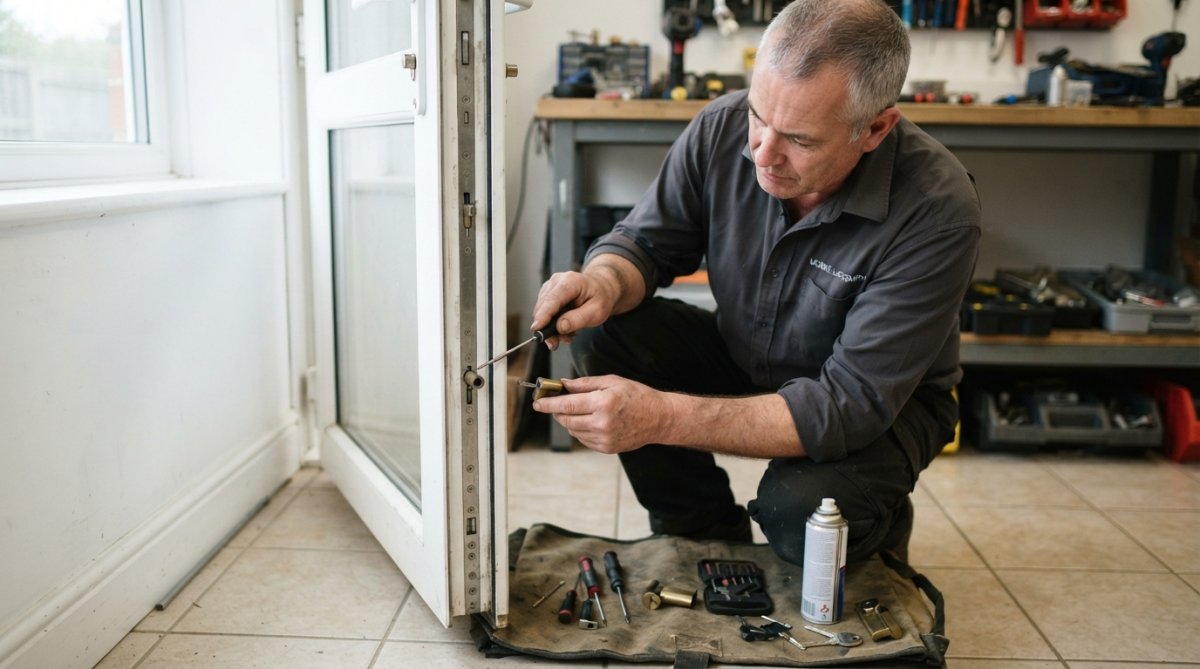
 how-to
How to Prevent uPVC Door Lock Mechanism Failure
Table of Contents
- Why uPVC Door Lock Mechanisms Fail
- Signs of a Failing Multipoint Lock
- The Best Lubricant for uPVC Door Locks
- How to Fix uPVC Door Alignment Issues
- Seasonal Maintenance for uPVC Door Locks
- Preventative Security Upgrades for uPVC Doors
- DIY vs. Professional Locksmith: When to Call for Help
- Frequently Asked Questions
Last Updated: September 14, 2026
Why uPVC Door Lock Mechanisms Fail
Most uPVC door lock failures trace back to neglect. The multipoint locking mechanism is a precision assembly of levers, cams, and springs that relies on clean, protected metal surfaces to move freely. When that protection breaks down, friction takes over.
Your door handle turns a spindle that drives a gearbox, which pushes shoot bolts, hook bolts, and locking cams into the door frame keeps. Every contact point needs lubrication and correct alignment. Miss either, and you get a stiff handle, a door that won't lock, or a gearbox that strips its internal teeth.
Three forces cause most failures:
- Wear and tear on the gearbox and spring cassettes after years of daily use
- Misalignment between the door and frame, often caused by thermal expansion or sagging hinges
- Corrosion and grit inside the locking strip, which grinds down internal components
A stiff handle usually means the mechanism is dry or the door has dropped on its hinges, not that the lock is broken. Fix those two things first and you'll solve most problems before they become a lock failure.
Signs of a Failing Multipoint Lock
Catching a failing multipoint locking mechanism early saves you from a full gearbox replacement. The warning signs are consistent across almost every uPVC door.
Watch for a handle that needs two hands to lift, grinding or clicking as you turn the key, or a door that needs a shoulder to close. These early indicators are your cheapest window to act.
Gearbox Wear and Handle Problems
The gearbox converts the handle's rotation into movement of every locking point. When it wears, the handle feels spongy or drops under its own weight. A spring cassette failure produces the same symptom and is cheaper to replace.
If the handle turns but nothing engages, the gearbox has likely stripped internally. That's a replacement job, not a repair.
Locking Points That No Longer Engage
Test each locking point with the door open. Lift the handle and watch the shoot bolts and hook bolts extend. If any stay retracted, the locking strip has seized or slipped out of alignment. A locking cam that no longer reaches its keep means the door isn't secure, even when it looks shut.
The Best Lubricant for uPVC Door Locks
Dry lubricant is the right choice for a uPVC door lock, not oil or grease. Oil attracts dust and grit, which turns into an abrasive paste inside the locking strip and accelerates wear and tear. A PTFE-based or silicone-based dry lubricant coats the metal, dries clean, and keeps internal components moving without collecting dirt.
Silicone spray works well for hinges and the exposed parts of the locking strip. For the gearbox and spring cassettes, a dry PTFE spray is better because it penetrates and then sets.
How to apply it correctly:
- Open the door and locate every moving part: gearbox, locking strip, keeps, and hinges.
- Spray a short burst into each locking point and along the strip.
- Work the handle up and down several times to distribute the lubricant.
- Wipe away any excess so it doesn't drip onto the frame.
- Repeat every six months, or quarterly if the door faces coastal weather.
Never use WD-40 as a long-term lubricant (Find out more about the iconic WD-40 brands and its history). It's a water displacer, not a lubricant, and it will leave the mechanism drier than before once it evaporates.
How to Fix uPVC Door Alignment Issues
uPVC door alignment issues usually show up as a door that catches on the frame, a handle that won't lift fully, or a gap you can see daylight through. The cause is almost always the hinges, not the lock. Correct the alignment and the lock starts working again.
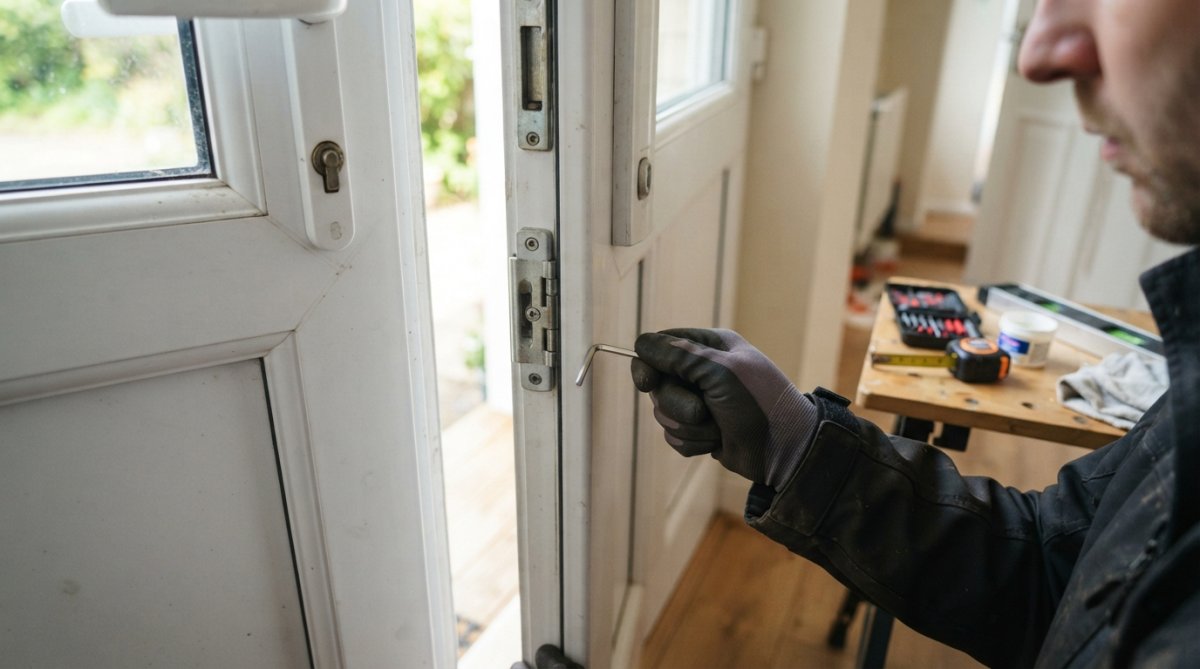
Start by checking the gap around the door. An even gap means the frame is fine and the problem is internal. A gap that's tight at the top and wide at the bottom means the door has dropped.
Adjusting Hinges and Locking Strips
Most uPVC doors have adjustable hinges with two or three screws for horizontal, vertical, and compression adjustment. The horizontal screw moves the door sideways; the vertical screw raises or lowers it.
- Horizontal adjustment: moves the door toward or away from the hinge side
- Vertical adjustment: lifts a dropped door back into square
- Compression adjustment: controls how tightly the door presses against the seal
Adjust in quarter turns and test after each one. Once the door sits square, check that every locking point meets its keep. If a keep is out of line, loosen its screws, tap it into position, and retighten.
Seasonal Maintenance for uPVC Door Locks
Temperature changes move uPVC more than most people realise. A typical white uPVC door panel can expand and contract by several millimetres across a year. That's why a door that sticks in July often works fine by October, it isn't a fault, it's the material behaving as designed, and the mechanism has to be adjusted to follow it.
A seasonal routine keeps the mechanism ahead of those shifts, adjusting hinge tension and compression to match the season.
Spring: Reset After Winter Contraction
Winter pulls the panel tight against the frame, compressing seals and loading the hinges. By spring the door may have dropped slightly or the handle may feel heavier than it should.
- Check the gap around the door with the door closed. An even 3-5 mm gap all round is healthy.
- Lubricate every moving part with a dry PTFE or silicone spray: gearbox, locking strip, keeps, and hinge pivots.
- Work the handle up and down several times to distribute the lubricant.
- If the door has dropped, make a small vertical hinge adjustment (see below) to bring it back into square.
Summer: Manage Expansion and Compression
Heat expands the panel and can push it against the frame, making the handle stiff and the door hard to close. Reduce compression rather than force the lock.
- Loosen the compression adjustment on each hinge by a quarter turn to relieve pressure on the seal.
- If the door is catching on the keep side, make a small horizontal adjustment to move the door away from the frame.
- Re-check that every locking point still meets its keep. Expansion can push a shoot bolt past its keep, so the door looks shut but isn't secure.
- Re-lubricate if the handle feels dry.
Autumn: Prepare for Damp and Grit
Autumn brings leaf litter, grit, and damp. Grit inside the locking strip is one of the fastest ways to wear down internal components.
- Clean the locking strip and keeps with a dry brush or cloth before lubricating.
- Spray the locking strip and hinges with silicone spray, which displaces moisture better than PTFE in damp conditions.
- Check door seals and drainage channels. A blocked drain channel lets water sit against the frame and accelerates corrosion.
- Test the key in the cylinder. If it feels gritty, a graphite-based lock lubricant is appropriate for the cylinder itself, not the multipoint mechanism.
Winter: Watch for Contraction Gaps
Cold contracts the panel, which can open a gap between the door and the seal and make the handle feel loose.
- Check for draughts around the edge. A visible gap means the compression adjustment needs tightening by a quarter turn.
- Re-lubricate the mechanism, as cold thickens any residual lubricant.
- If the key is stiff, don't force it. Cold can make a worn cylinder bind, and forcing it can snap the key or damage the cylinder.
How to Adjust Hinge Tension Seasonally
Most uPVC doors use adjustable hinges with two or three screws for horizontal, vertical, and compression adjustment. Adjust in quarter turns and test after each one.
- Horizontal adjustment: moves the door toward or away from the hinge side. Use this when the door catches on the frame.
- Vertical adjustment: lifts a dropped door back into square. Use this after winter contraction.
- Compression adjustment: controls how tightly the door presses against the seal. Loosen in summer, tighten in winter.
A maintenance schedule built around the seasons prevents most lock failure before it starts. Ten minutes twice a year is cheaper than a gearbox replacement, and it keeps the door working the way it was designed to.
Preventative Security Upgrades for uPVC Doors
Standard uPVC locks meet basic requirements, but they can be upgraded. The single most effective change is fitting an anti-snap cylinder (Secured by Design). Snap-off attacks target the part of the cylinder that protrudes from the door; an anti-snap cylinder breaks in a way that leaves the lock intact.
Other worthwhile upgrades:
- High-security handles with a built-in lock, so a burglar can't simply remove the handle
- Security keeps that resist being prised open
- Reinforced strike plates on the frame side
These upgrades don't stop a determined attacker, but they raise the effort required. Most domestic burglaries are opportunistic, and two extra minutes of resistance is usually enough to send someone elsewhere.
DIY vs. Professional Locksmith: When to Call for Help
Most routine preventative maintenance is a DIY job: lubrication, hinge adjustment, and cleaning. You need an Allen key set, a screwdriver, and a can of dry lubricant. But before buying any replacement part, you need to know exactly which multipoint lock you have, because gearboxes and locking strips are not interchangeable between manufacturers.
Identify Your Multipoint Lock Before Buying Parts
Multipoint locks are made by several manufacturers, and the differences matter. Common names on the locking strip or gearbox include Yale, Fuhr, GU, Mila, and Winkhaus. Each has its own backset (distance from the door edge to the centre of the spindle), faceplate width, and locking point configuration.
To identify yours:
- Open the door and look at the faceplate on the edge of the door. The manufacturer's name or logo is often stamped or printed there.
- Measure the backset. This is the distance from the faceplate to the centre of the handle spindle. Common measurements are 35 mm, 40 mm, and 45 mm.
- Measure the faceplate width. Common widths are 16 mm and 20 mm.
- Note the number and type of locking points: shoot bolts, hook bolts, rollers, or cams.
- Take a photograph of the full locking strip and the gearbox before ordering anything.
If you can't find a name, take the photo to a locksmith or a door hardware supplier. They can usually identify the mechanism from the locking point pattern alone. Buying the wrong gearbox is one of the most common and expensive mistakes in uPVC door repair.
When a DIY Fix Becomes a Safety Risk
Some jobs are safe to attempt. Others are not.
Safe DIY jobs:
- Lubricating the mechanism
- Adjusting hinges
- Cleaning the locking strip and keeps
- Tightening or repositioning a keep
Jobs that need a professional:
- Replacing a gearbox
- Replacing a cylinder
- Replacing the full multipoint locking strip
- Any work where the door is the only means of escape
A gearbox replacement requires the correct part, the right tools, and knowledge of how the locking strip connects. Forcing a gearbox or misaligning the strip can damage the door panel, and uPVC panels are expensive to replace. More importantly, a door that doesn't lock properly is a security risk, and if your insurance requires a working multipoint lock, a claim after a break-in could be refused.
Warranty and Insurance Considerations
Attempting a repair yourself can void a warranty on a new door or recently fitted lock. Check the terms first, if the door is still under a manufacturer's warranty, a professional repair is usually safer.
Most insurance policies require the door to be locked with a working multipoint mechanism when you leave the property. A door that closes but doesn't fully engage its locking points may not meet that requirement, if unsure, ask your insurer.
If you're locked out or your door won't secure, don't leave it. A door that won't lock is an open door, and waiting until morning rarely ends well.
Frequently Asked Questions
What are the common causes of uPVC door locking mechanism problems?
Most uPVC door lock failures start with wear and tear on the multipoint locking mechanism, especially the gearbox. Dirt and grit inside the lock case cause friction, while thermal expansion in summer and contraction in winter can push the door out of alignment. A stiff handle, dropped door, or misaligned locking points all put extra strain on internal components. Regular cleaning and lubrication of the locking strip and cylinder prevents most of these issues from developing.
What is the best lubricant for uPVC door locks?
A dry lubricant such as silicone spray or PTFE-based spray works best for uPVC door locks. These dry films attract less dirt than wet oils and won't gum up the internal components over time. Apply the spray to the locking strip, keep, shoot bolt, hook bolt, and spindle, then work the handle up and down several times to distribute it. Avoid standard WD-40 or thick grease, as these collect grit and can make the mechanism stiffer.
How often should I service my uPVC door locks?
Aim to lubricate and check your uPVC door lock every six months, ideally in spring and autumn before seasonal temperature changes. If your door faces direct sun or coastal wind, service it every three to four months. Wipe the locking strip clean first, then apply a dry lubricant. Check the handle action and look for any play in the hinges. This simple maintenance schedule prevents most lock failure and keeps the door secure.
Can temperature changes cause uPVC door locks to fail?
Yes. uPVC expands in heat and contracts in cold, which can push the door out of alignment and misalign the locking points. In summer, a door that sticks or a stiff handle often signals thermal expansion. In winter, gaps can appear around the frame. Adjusting the hinges and locking strips seasonally corrects this. If the gearbox already feels rough or the handle drops, the mechanism may need replacing rather than just adjusting.
A door that won't lock properly leaves your home exposed, and it's rarely a problem that fixes itself. If your uPVC door needs attention and you want it sorted quickly, Mobile Keys Norfolk offers 24/7 availability, on-site service, and a 30-minute arrival time across the county, so you're never left waiting or stranded. Call 07399 583760 and get your door secure again.