 how-to
Emergency Car Key Replacement for Classic Cars
Table of Contents
- Lost Your Only Key? Steps to Take Right Now
- Emergency Car Key Replacement for Classic Cars: What to Expect
- How to Find a Key Code for a Classic Car
- The On-Site Key Cutting Process for Vintage Vehicles
- Classic Car Lock Repair Services vs. Replacement
- Preservation vs. Replacement: Keeping Your Classic Original
- Costs, Insurance, and Documentation for Key Replacement
- Conclusion: Getting Back on the Road
- Frequently Asked Questions
Last Updated: September 6, 2026
Lost Your Only Key? Steps to Take Right Now
Losing the only key to a classic car is a different kind of panic. Modern cars have dealership databases and app-based access; a vintage vehicle often depends on a single piece of cut metal that is decades old. Emergency car key replacement for classic cars requires a specialist who understands older locking mechanisms, not just a generic auto locksmith.
Your first move is to stop and assess the situation. Check pockets, bags, and the usual spots near where you parked. If the key is genuinely gone, do not attempt to force entry or remove the lock yourself. A damaged door lock or ignition barrel turns a simple replacement into a costly restoration job.
We handle these exact scenarios across the region. A classic car key replacement needs the right key blank, the correct key profile, and careful cutting to match the original lock assembly. Before you call anyone, locate your vehicle registration document (V5C) and any proof of ownership. A professional auto locksmith will ask for this to verify the vehicle is yours, and having it ready speeds up the entire process (gov.uk).
Contact a mobile locksmith who offers 24/7 availability. Waiting until morning risks leaving your historic car exposed overnight, which is a security risk no owner should take. A rapid response protects both your vehicle and your peace of mind.
Emergency Car Key Replacement for Classic Cars: What to Expect
A professional mobile service arrives at your location with the locksmith tools and key blanks needed to cut a new key on-site. For classic cars, the process is often simpler than for modern vehicles because many older models use a straightforward mechanical key without an immobilizer or transponder chip.
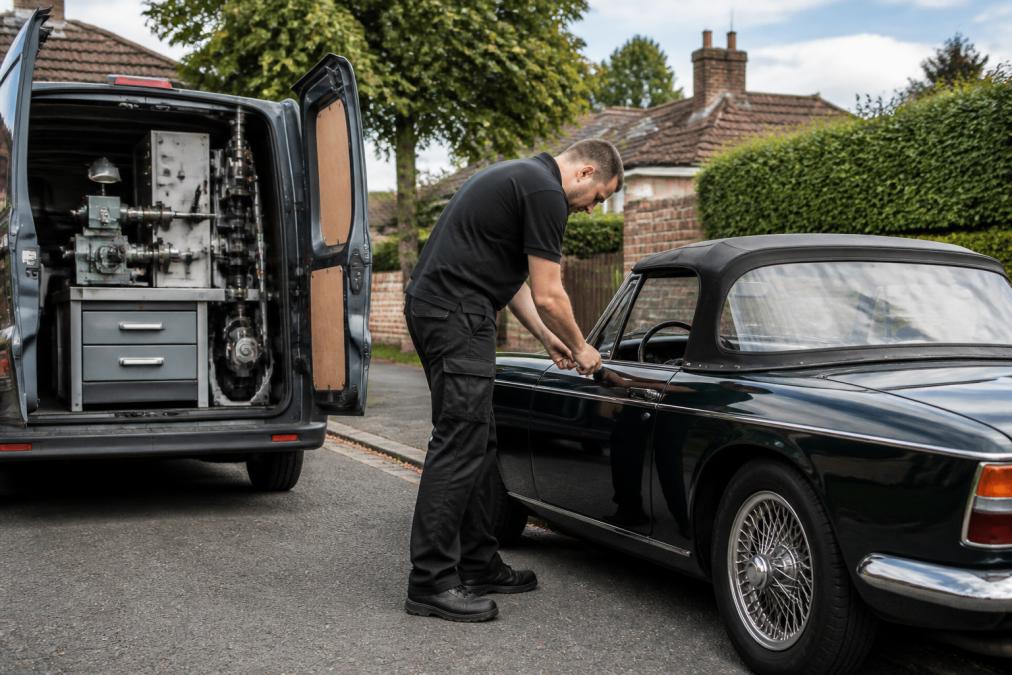
The technician will first inspect the door lock and ignition barrel to determine the key profile. They may remove the lock to read the internal wafers, or they might work from a key number if you have one. Once the correct key blank is identified, the cutting process takes only a few minutes.
Time is the real advantage here. A mobile locksmith can usually complete the job in under an hour, compared with a dealership that may need to order parts and schedule you in days later. That speed matters when you are stranded.
How to Find a Key Code for a Classic Car
A key code is the fastest route to a new key, but on a classic car it is rarely as simple as reading a sticker. Unlike modern vehicles with a central database, a 1960s MGB or a 1970s Triumph Spitfire may have its code stamped in one of several places, or not at all. Knowing where to look and what you are looking for separates a ten-minute job from an afternoon of lock disassembly.
Where Manufacturers Hid the Code
British Leyland, Rootes, and Ford of Britain did not follow a single standard. Common locations include:
- The key itself: Many original keys had the code stamped on the bow (the plastic or metal head). Look for a four- or five-digit number, sometimes preceded by a letter like 'X' or 'N'.
- The door lock face: On some models, the code is stamped on the outer rim of the lock barrel, visible only when the handle is removed.
- The ignition barrel body: Often stamped on the side, visible with the steering column cowl removed.
- The glovebox lock: Frequently overlooked, but often carries the same code as the doors.
- The original key tag: A small metal or plastic tag that came on the key ring from the factory. If you have the original service book, the code is sometimes written inside the front cover.
Decoding the Code Format
Most British classic car key codes are either direct (the number corresponds to a specific bitting pattern) or indirect (the number references a series in a code book). For example, a Hillman Minx from the 1960s might use a code like '12345' that a locksmith can look up in a manufacturer's code series. A Jaguar E-Type, by contrast, often uses a letter-prefix code that requires a different blank series.
If you find a code, do not assume it is complete. A worn stamping can turn a '6' into an '8' or a '3' into a '5'. Take a clear photograph with raking light and compare it against the same stamp on the opposite lock if one exists.
When the Code Is Missing
Without a code, the locksmith will decode the lock directly. This means removing the door lock or ignition barrel and reading the wafer positions. Each wafer has a height number (typically 1 through 5 on British locks), and the sequence of those numbers across the lock is the bitting code. This is a standard procedure, but it requires care: a seized screw on a 50-year-old door handle can easily snap, turning a key replacement into a trim repair.
A Practical Tip for Owners
Before you need an emergency replacement, spend ten minutes with a torch and a magnifying glass. Check the key, the lock faces, and the service book. If you find a code, photograph it and store it in your phone's notes app alongside a photo of your V5C. That single image can save you an hour of labour charges on the day you are stranded.
The On-Site Key Cutting Process for Vintage Vehicles
On-site key cutting for a classic car follows a methodical process that protects the vehicle's original hardware. The locksmith begins by evaluating the lock condition, since decades of use can wear the internal wafers and affect how a new key fits.
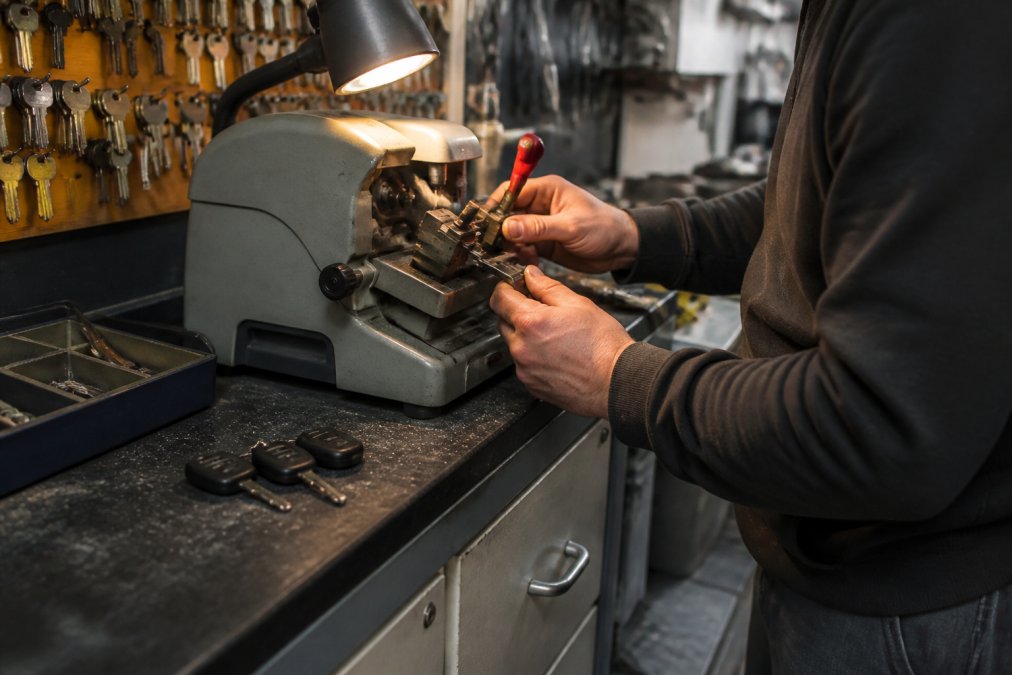
The technician selects the correct key blank for your make and model. Classic cars use a wide variety of key profiles, and using the wrong blank can damage the lock. The blank is then cut using either a manual cutter or a code-cutting machine, depending on whether the locksmith is working from a key code or decoding the lock directly.
After cutting, the new key is tested in the door lock, ignition barrel, and any other locks it should operate, such as the boot or petrol cap key. This testing phase is critical. A key that works in the door but sticks in the ignition is a common issue with worn locks, and a skilled locksmith will adjust the key rather than force it.
The entire process typically takes 30 to 60 minutes on site.
Classic Car Lock Repair Services vs. Replacement
Not every lock problem requires a new lock. Understanding when to repair versus replace saves money and preserves the vehicle's originality.
| Situation | Best Option | Why |
|---|---|---|
| Worn wafers causing key sticking | Repair | New wafers restore smooth operation |
| Broken key inside the lock | Key extraction | Remove debris, then cut a new key |
| Corroded or seized lock mechanism | Replacement | Internal damage is often beyond repair |
| Lock cylinder damaged by forced entry | Replacement | Structural damage compromises security |
| Original key works but is worn | Key duplication | Cut a fresh copy before the old one snaps |
A common mistake is assuming a seized lock needs full replacement. Often, the issue is simple corrosion or a buildup of old lubricant. A professional can strip the lock, clean it, and replace worn wafers, restoring function while keeping the original cylinder in place.
Replacement becomes necessary when the lock assembly is physically damaged or when the internal mechanism has worn beyond economical repair. In these cases, a locksmith can source a new lock that matches the original specification or rekey an existing unit to work with your new key.
Preservation vs. Replacement: Keeping Your Classic Original
Classic car owners face a constant tension between originality and practicality. A numbers-matching vehicle with all its original locks holds more value to collectors, but original locks are often worn and less secure.
Preservation makes sense when the lock is functional and simply needs a new key or minor servicing. Keeping the original lock assembly maintains the car's authenticity and avoids the hassle of matching a new lock's finish to decades-old hardware.
Replacement is justified when security is genuinely compromised. Vintage locks offer minimal protection by modern standards. The UK Government guidance on vehicle security notes that older locking mechanisms are easier to bypass. If you regularly park your classic in public or urban areas, upgrading the locks or adding a secondary security device may be worth more than preserving absolute originality.
A middle path exists. Many owners keep the original door and ignition locks for authenticity while fitting a hidden immobiliser or steering lock for actual security. This approach respects the vehicle's heritage without leaving it vulnerable.
Costs, Insurance, and Documentation for Key Replacement
Emergency key replacement for a classic car is not a fixed-price service. Unlike a modern Ford Fiesta where a dealership can quote from a chassis number, a 1968 Austin Healey Sprite may require a locksmith to decode a lock on-site, source an obsolete blank, and hand-cut the key. That complexity is reflected in the price.
What You Should Expect to Pay
As a guide, UK auto locksmiths typically charge:
- Call-out fee: £50-£90 depending on distance and time of day. A 2am call-out on a Sunday will sit at the top of that range.
- Standard key cutting (on-site, no code): £60-£120. This covers the locksmith's time to remove a door lock or ignition barrel, decode the wafers, and cut a new key.
- Key cutting from a code: £40-£80, assuming the locksmith has the correct blank in stock or can source it quickly.
- Ignition barrel removal: £40-£100 extra if the barrel is seized or requires specialist tools to extract without damaging the steering column.
- Transponder or immobiliser programming: £80-£150 for the rare classic that has been fitted with an aftermarket immobiliser.
These figures are typical for independent mobile locksmiths across England and Wales as of 2025. A main dealer for a heritage marque such as Jaguar or Aston Martin will quote considerably more, often £200-£400, because they will order a key from the factory and may require the car to be towed to their workshop.
Insurance: What Classic Car Policies Actually Cover
Classic car insurance differs from standard motor policies. Specialist providers such as Adrian Flux, Lancaster Insurance, and Peter James Insurance commonly include key replacement cover as a standard benefit or a low-cost add-on. The cover usually reimburses you for the cost of a replacement key and lock changes if the key is lost or stolen.
However, read the small print. Many policies limit key cover to £500-£1,000 per claim, which is usually sufficient for a classic car but may not cover the cost of replacing a full set of matching locks across doors, boot, and ignition. Some policies also require you to use an approved locksmith, which may not be the nearest available in an emergency.
If your policy does not include key cover, a standalone key protection policy is rarely worth it for a classic car. The annual premium often exceeds the cost of a single replacement key. Instead, put the money towards a spare key now.
Documentation: What a Locksmith Legally Needs
A reputable locksmith will not cut a key for a vehicle without proof of ownership. This is not bureaucracy; it is a legal safeguard under the Theft Act 1968, which makes it an offence to possess or make a key for a vehicle without the owner's authority (legislation.gov.uk).
For a classic car, the accepted documentation is:
- V5C logbook (the green slip or the newer red-ink version) showing your name and address.
- Photo ID, a driving licence or passport.
- Proof of address if the V5C is not in your current name, such as a recent utility bill.
If the car is not registered in your name, for example, you have just bought it and the V5C has not arrived, a locksmith may accept a bill of sale plus the previous owner's V5C section, but this is at their discretion. Do not expect a mobile locksmith to cut a key on the spot without this paperwork.
The Documentation Gap Most Owners Miss
For a classic car without a key code, the locksmith may need to remove the lock to decode it. If you have the original service book or a heritage certificate from the manufacturer, bring it. The heritage certificate from Jaguar Land Rover Classic or the British Motor Industry Heritage Trust (BMIHT) often includes the original key code. That single document can turn a £120 decoding job into a £40 code-cut job.
Conclusion: Getting Back on the Road
Losing the only key to a classic car is stressful, but the solution is straightforward when you know who to call. A specialist mobile auto locksmith can cut and program a replacement on-site, often within the hour, without towing your vehicle to a garage or paying dealership prices.
The key is acting quickly, preparing your documentation, and choosing a service that understands vintage vehicles. Mobile Keys Norfolk offers 24/7 availability and a 30-minute arrival time across Norfolk, bringing the right equipment and expertise directly to you. Our team gets you back on the road quickly and efficiently.
Call 07399 583760 for immediate assistance with your classic car key replacement.
Frequently Asked Questions
Can a mobile locksmith cut keys for vintage vehicles on-site?
Yes. Modern mobile locksmiths carry the equipment to cut older mechanical keys on-site. For classic cars without transponder chips, a skilled locksmith can often cut a new key from the lock itself or a key code. If the vehicle has an immobiliser or a later electronic system, the locksmith will need the right diagnostic tools to program a new key, just as they would for a modern car.
What information do I need to provide to get a replacement classic car key?
Proof of ownership is essential. A V5C logbook and photo ID are the standard documents a legitimate locksmith will ask for. If you have the original key number or a key code, bring that too, as it speeds up the process. If the car has an ignition or door lock that can be removed, a locksmith can often cut a key from the lock's internal code.
How long does it typically take to replace a lost classic car key?
For a classic car, the time required to cut a replacement key on-site varies depending on the vehicle's specific needs and whether it has a transponder chip or immobiliser. In an emergency, a locksmith can often get you moving quickly.
Is it possible to repair a damaged classic car lock or ignition?
Often, yes. Depending on the damage, a locksmith may be able to repair a worn ignition barrel or door lock. This can involve re-keying the cylinder or replacing worn components. If the lock is beyond repair, a new lock assembly matched to your key may be an option.